Through the awareness-raising sessions, I learned that regular handwashing, promptly reporting symptoms, and avoiding high-risk contact could save lives

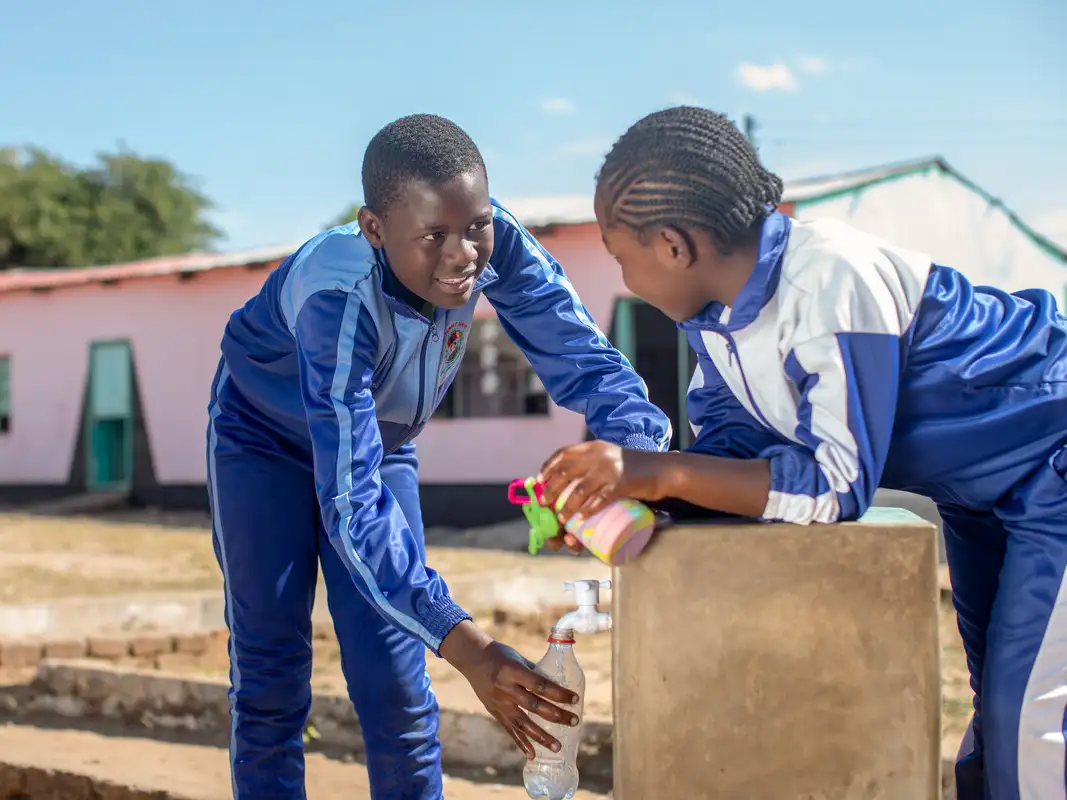
Women washing their hands before entering a designated safe space
A deadly new strain of Ebola is spreading rapidly across the Democratic Republic of Congo (DRC). Since the outbreak was declared, more than 1094 cases have been confirmed, and at least 277 people have lost their lives to the disease.
Our expert, local partners are responding and working with local affected communities to address the outbreak of Ebola in DRC to prevent the disease spreading. Your donation today will help our neighbours who are directly affected by this emergency.
In May 2026, an Ebola outbreak involving a new strain of the virus was confirmed in DRC.
Ituri province, in the north-east of the country, is the epicentre of the outbreak. But the virus has crossed into neighbouring North and South Kivu provinces, including the major transit hub of Goma. Cross-border transmission has also been verified, with 20 cases identified and two deaths in Uganda. To halt further spread, containment measures and border closures are now in effect.
This new strain currently has no vaccine, and no known effective treatments, so controlling the spread of the virus is vital to keeping communities safe.
The Ebola outbreak comes at an incredibly difficult moment for the DRC, as the country is already reeling from a severe humanitarian crisis driven by escalating violence in its eastern provinces.
The conflict has left had a devastating impact on the country’s healthcare system and medical infrastructure. In conflict zones like North Kivu, up to 70% of health facilities are completely non-functional. Recent global aid cuts, combined with a fragile health system already strained by ongoing conflict and displacement, have left the country less resilient and less able to respond quickly and at scale.
With your support, our expert local partners are responding and working alongside communities. Thanks to donations from the Catholic community, they are providing life-saving prevention information, hygiene kits, personal protective equipment for healthcare workers, as well as food for vulnerable families and water and sanitation support.
In many parts of the DRC, the Catholic Church is one of the most trusted providers of healthcare and operates an estimated 45% of the country’s health facilities. Priests, nuns and other faith leaders hold key positions of trust in their communities, and are vital for helping disseminate information about how to stop the spread of the disease.
In a letter for the Archbishops and Bishop of England and Wales, the National Bishops’ Conference of the Congo said:
“In the Democratic Republic of the Congo, the Catholic Church is not only a spiritual guide; it is also one of the country’s main healthcare providers, through a vast network of hospitals, health centres and clinics on which millions of people depend every day. Because our facilities are already established in remote and affected areas, our medical staff are directly on the front line for detecting cases and caring for the sick.
"In this difficult context, we are pleased to note that our friends at CAFOD are already supporting their partners on the ground, playing a vital role as a bridge between major international humanitarian aid mechanisms and our local religious communities. This supportive role is now more important than ever. This new outbreak is not merely a health emergency; it is also a test of the international community’s ability to learn from the past by recognising and supporting church institutions already working on the front line.
"At this dark hour for our country, we humbly ask for the prayers, solidarity and support of the Catholic community in England and Wales.”
Because of their traditional roles as primary caregivers and frontline community health workers, women face the highest risk of exposure to the virus. Yet, because of these very roles, they also hold the keys to community trust. That’s why our partners are working to support women to protect themselves and take a lead in efforts to successfully contain the virus.
“When the first Ebola cases were reported our community was very worried,” says Emmanuel. Living in Ituri province, close to the heart of the outbreak, news of the disease very quickly reached his village quickly. But with very little official information available, fear took hold. No one was sure how the disease spread, or how to protect themselves from it. And rumours began to fly that no one who was infected could survive.
“Many people were afraid and did not know how to protect themselves – it was a sentiment of being powerless and very discouraged. Rumours spread quickly, and several families were afraid to visit health facilities.”

Thanks to your support, our partners arranged several awareness raising sessions, and began broadcasting vital information about the disease over the radio in local languages. They also trained members of the community and local leaders to act as volunteers, so they could serve as accurate sources of information on how people could protect themselves and prevent the spread of the disease.
“Through the awareness-raising sessions, I learned that regular handwashing, promptly reporting symptoms, and avoiding high-risk contact could save lives,” says Emmanuel. “I shared this information with my family and neighbours.”
As vital as the information on staying safe was, for Emmanuel there was something else, just as important, his community needed – a sense of hope. As deadly as this disease is, there are survivors – and our partners have helped them share their stories, to inspire others to seek treatment, and to let people know survival is possible.
“When the first Ebola survivor in our community publicly shared his experience, it profoundly changed the perception of many community members,” says Emmanuel. “His recovery demonstrated that the disease could be overcome if people sought medical care early enough.
“The testimonies of Ebola survivors even if they are still very very few as compared to those who pass away are very important for our community- we can still have hope. Seeing that a person infected with Ebola could receive treatment and be reunited with their family gave hope to many of us.”
The outbreak is far from over, but with your support our local partners will continue to stand with communities like Emmanuel’s, ensuring they have all the information they need to stay safe, stay strong, and stop the spread.
CAFOD has committed emergency funding and is working through trusted local Church partners to help communities fight the spread of the disease.
Your donation will help our partners provide:
life-saving prevention information
hygiene kits and food to quarantined and vulnerable families
personal protective equipment (PPE) for healthcare workers
information on safe and dignified burials.
With no vaccine currently available for this strain, saving lives relies on containment of the virus.
You can help limit the spread of Ebola, and get support to affected communities, but acting quickly is critical. Donate today to stop the spread.
CAFOD’s partners have experience responding to Ebola outbreaks. When the World Health Organization (WHO) declared an Ebola outbreak in Democratic Republic of Congo (DRC) in 2018, CAFOD responded at the height of the disease. Thanks to donations from CAFOD supporters, our networks of Church aid workers and volunteers delivered life-saving prevention information and hygiene kits as well as safe and dignified burials and training.
CAFOD Director Christine Allen was in DRC during the previous outbreak of Ebola there. She told us:
"I've seen first-hand that halting the spread of this appalling disease requires a massive effort, on the part of the international community as well as the Congolese people and health authorities. What is critical is building trust within communities, meaning that the work of our local Church partners is essential."
Your donation today means we can quickly respond to the new outbreak.
The Ebola virus disease is a severe acute viral illness. Its symptoms include:
fever
intense weakness
muscle pain
headache
sore throat.
This is followed by vomiting, diarrhoea, rash, impaired kidney and liver function, and, in some cases, both internal and external bleeding.
The Ebola virus first emerged in Democratic Republic of Congo in 1976 and it is thought to infect humans through contact with infected animals, including chimpanzees, fruit bats and forest antelope.
There are different strains of Ebola. The current strain identified in DRC is caused by the Bundibugyo virus and has no vaccine.
The most commonly used treatment is to keep the patient hydrated, as is the case with most fevers. Patients have a better chance of survival if they are diagnosed early and receive early treatment.
The virus is transmitted between humans via bodily fluids and via surfaces that a sick person has come into contact with: for example, bed sheets or shared towels. Even funeral ceremonies for Ebola victims can cause risks if mourners have direct contact with the bodies of infected people.
By following a few important procedures, the spread of the Ebola virus can usually be stopped relatively easily. Patients need to be kept in isolation, and their nurses or visitors must wear protective suits or avoid coming into direct contact with them.
One reason that the virus has previously spread so extensively in parts of Africa is a widespread fear and lack of trust in the advice given on Ebola prevention. Many people don’t have access to reliable information, and high death rates and stigmatisation make people afraid to take their loved ones to hospitals, even if medical facilities are available.